The carbonized papyrus scrolls left behind by the eruption of Vesuvius have taken another step forward with the help of AI.
According to reports from CNN, The Guardian, and others, researchers used high-resolution X-ray scanning, computer vision, and machine learning to read more text from a Herculaneum scroll that was burned by volcanic heat and cannot be physically unrolled. The scroll, cataloged as PHerc 1667, comes from the ancient Roman site of Herculaneum and is about 2,000 years old.
What makes this interesting is not simply that “AI read ancient writing” again. It shows a new path for recovering texts: do not open the scroll, do not scrape the surface, and do not damage the artifact. Instead, use scan data and algorithms to digitally unfold a text that has been rolled and crushed into a fragile object.
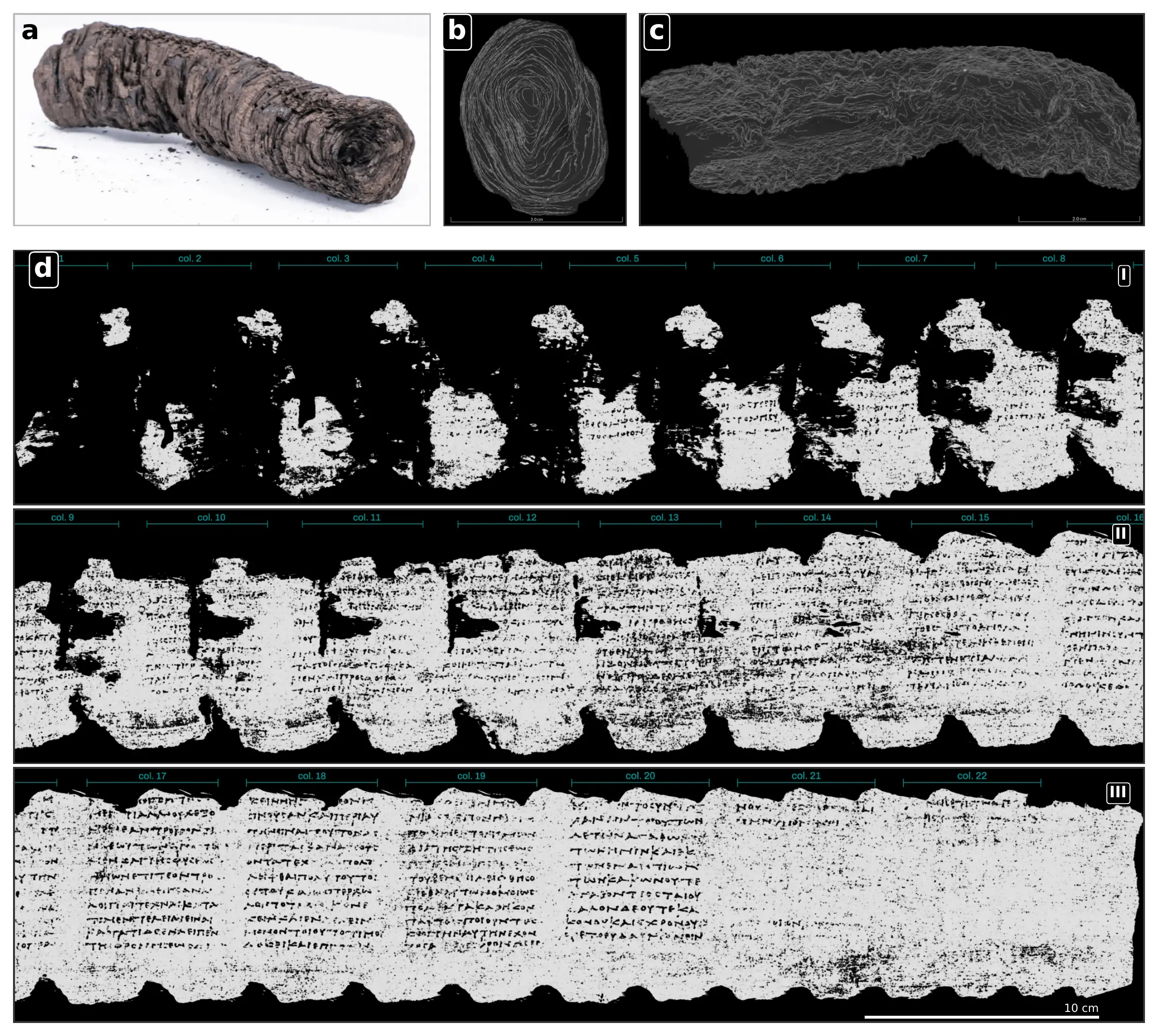
Image source: Vesuvius Challenge. This figure makes the core difficulty clear: researchers are not working with a flat page, but with a carbonized, compressed, tightly layered ancient papyrus scroll.
Why These Scrolls Are Special
In 79 CE, Mount Vesuvius erupted and buried Pompeii, Herculaneum, and other ancient cities under ash, debris, and intense heat. Herculaneum contained a famous villa later known as the Villa of the Papyri. Archaeologists found many ancient scrolls there.
The problem is that these scrolls were carbonized by heat. They look like blackened pieces of charcoal and are extremely fragile. In the past, forcing them open could easily tear the papyrus apart, destroying the text along with it.
For a long time, these scrolls were like hard drives sealed by history: the contents might be important, but they were almost impossible to read safely.
What Did AI Actually Do?
The method can be understood in three steps.
First, researchers scan the scroll with high-resolution X-rays to obtain its internal 3D structure. The papyrus is not physically opened, but the scan can reveal how the layers sit against each other.
Second, algorithms attempt a “virtual unwrapping.” In other words, the rolled, compressed, distorted papyrus layers are unfolded in digital space into something closer to a flat surface.
Third, machine learning models detect ink traces. The hard part is that the ink on Herculaneum papyri has very low contrast against the carbonized papyrus. Human eyes can barely distinguish it. The model has to infer where letters may be from subtle texture, density, and shape changes.
This is not traditional OCR, where a clear image is turned into text. It is more like finding nearly invisible ink traces inside a 3D mass of carbonized material, then arranging them into readable text.
What Was Read This Time?
Reports say researchers identified about 20 columns of text from PHerc 1667. The content is related to Stoic philosophy and may involve ethics, reason, ways of life, or ancient philosophical discussion.

Image source: Vesuvius Challenge. This image shows the virtually unwrapped writing surface. The denser text on the right also explains why continuous passages matter much more than isolated words.
This kind of result may not rewrite classical studies overnight, but it matters in several practical ways.
First, it shows the method is moving from “reading a few words” toward “reading continuous passages.” Once there is enough continuous text, scholars can start judging authorship, topic, genre, and intellectual context.
Second, it provides a technical path for other unopened scrolls. Large amounts of Herculaneum papyrus material remain unread. If the method keeps improving, more ancient texts may appear in the future.
Third, it clarifies the role of AI in scholarship. AI is not replacing classicists. It is turning previously unreadable material into something scholars can study. Interpretation, collation, dating, and intellectual analysis still require historians, classicists, and papyrologists.
The Role of the Vesuvius Challenge
This progress is closely tied to the Vesuvius Challenge. The project opens scan data from Herculaneum papyri to researchers around the world and encourages machine learning, computer vision, and classical studies teams to work together on the problem of reading scrolls that cannot be unrolled.
Its approach fits modern AI research well: the problem is clear, the data is real, the evaluation target is concrete, and the work is deeply interdisciplinary. Participants need to understand image processing, papyrus structure, and collaboration with ancient-text experts.
More importantly, it turns a once highly closed artifact-reading problem into an open competition and collaboration effort. That is one reason Herculaneum scrolls have appeared so often in AI news in recent years.
Why Not Just Open the Scroll?
The obvious question for general readers is: if there is text inside, why not simply unroll the papyrus?
The answer is simple: it is too fragile.
These scrolls went through volcanic eruption, high-temperature carbonization, and nearly two thousand years of preservation. Their physical structure is extremely unstable. Historically, some attempts were made to mechanically unroll parts of scrolls, but the damage was severe. Today, researchers prefer non-destructive methods: scanning and algorithms.
That is where AI and imaging technologies become valuable. They are not merely “faster”; they make research possible where researchers previously did not dare, or could not safely proceed.
What This Means for AI
Projects like this remind us that one important direction for AI is not in chat interfaces, but in scientific toolchains.
Here, AI does not generate answers on its own. It is embedded in a full workflow:
- Artifact conservation sets the constraints.
- X-ray imaging provides the data.
- Computer vision processes the 3D structure.
- Machine learning models identify ink traces.
- Classicists interpret the text.
Its value comes from collaboration, not from one model being “smart” in isolation. This pattern will become more common in medical imaging, materials science, astronomy, archaeology, and archival restoration.
Stay Cautious
This progress should not be exaggerated into “AI has fully read an ancient Roman library.”
For now, only partial text can be read, and model judgments still need expert verification. Missing letters, shifted lines, unclear ink, and lost context all affect the final interpretation. Even when characters are recovered, they still need collation, translation, and scholarly debate.
The steadier way to put it is this: AI is helping researchers open materials that were almost unreadable before. It is not the endpoint. It is a new starting point for research.
My Take
What attracts me most about this story is that it pulls the AI conversation away from everyday tools and back toward human knowledge itself.
If more of these scrolls can be read, we may see lost philosophical works, ancient letters, literary fragments, or even works previously known only through quotations. Even if each attempt recovers only a few more columns, it is slowly reconnecting an ancient library sealed by a volcano to the present day.
For AI, that has more long-term meaning than “another chatbot.” It shows that algorithms are most valuable when they turn things humans could not touch, see, or read into material that can be studied further.